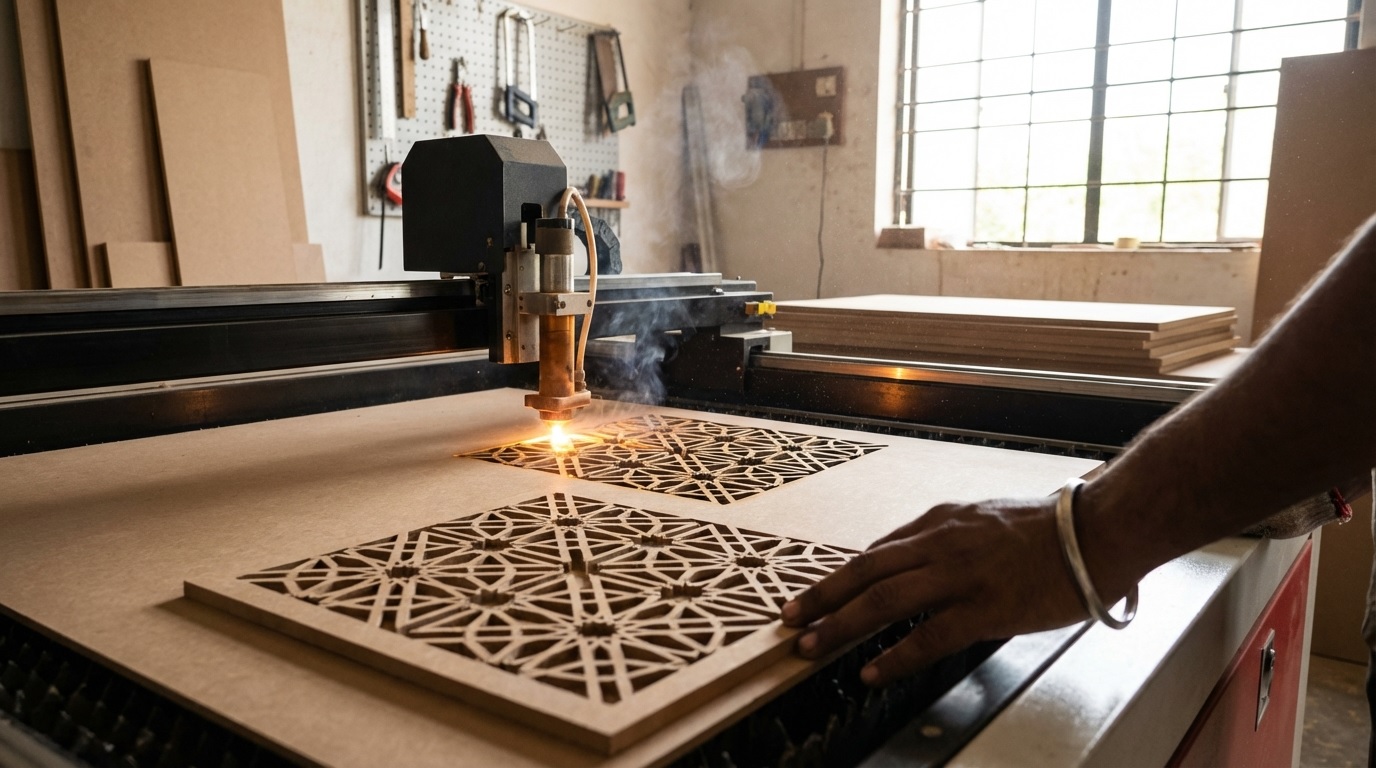
Cast and extruded acrylic respond differently to cutting tools, and for most interior projects that difference decides whether work stays in-house or goes to a fabricator before cost enters the picture. Material grade, dimensional tolerance, edge finish and residual stress each pull toward different equipment at different stages.
Cast and extruded acrylic cut like different materials
Acrylic sheet is polymethyl methacrylate, or PMMA, a rigid transparent thermoplastic sold in two grades. Manufacturers make cast acrylic by curing liquid monomer between glass plates, while extruded acrylic is pushed through rollers as a continuous sheet.
The two materials share a name and near-identical appearance, but they behave differently under every common cutting tool. Cast acrylic has a higher molecular weight, which gives it better resistance to heat and solvents during machining.
That rigidity makes PMMA useful for interior structures, and it also makes the material unforgiving of poor cutting. Acrylic chips under a dull edge and cracks at stress points that a softer plastic would simply absorb.
Under a CO2 laser, cast acrylic engraves to a clean frosted white, and fabricators rely on that reaction for signage and illuminated panels. Extruded acrylic tends to melt at the surface instead, so engraved detail comes out shallow and uneven.
The same gap shows up on a standard workshop table saw. Extruded sheet softens at a lower temperature, and the cut faces can re-weld behind the blade as the material cools. The panel leaves the saw looking severed, then snaps back as one piece.
Cast acrylic saws and routes with cleaner chip formation and less gumming at the blade. Grade selection happens at the purchase order, before any cutting plan exists. A studio that stocks only extruded sheet has already narrowed its finishing options.
In-house prototyping costs more than the machine
Desktop laser cutters can produce a first cut within the hour, which makes them feel fast. The scrap, repeat passes, dull tooling and hand finishing that follow are where the cost actually accumulates.
Bed size limits what a desktop machine can handle, because interior panels regularly exceed a desktop bed. Designs get split across tiles or shrunk from the dimensions the joinery actually needs.
Low wattage is another constraint. Low-power tubes need multiple slow passes on thicker sheet, and each pass adds heat to edges that were meant to stay stress-free.
Router work carries its own overhead, because acrylic dulls small carbide bits quickly. A dull bit stops slicing and starts rubbing, cut temperature climbs, and chips weld themselves to the edge.
Test cuts and kerf misjudgments add scrap on top of that labor. A failed panel cut from a full-price sheet costs the whole panel, and the machine time behind it is gone as well.
Turnaround stretches with every recut, and a job planned as one afternoon can run to a week once finishing is included. A fabricator’s queue, by contrast, runs while the studio gets on with other work.
The machine’s invoice doesn’t capture any of this. Operator hours and material write-offs are where the cost lands, and it grows with the size of the run.
Interior joinery tolerances leave little room for drift
Interior millwork holds acrylic to joinery standards. The specified tolerances determine how panels fit into joints and glazing systems.
Sheet thickness adds a second variable to every joint. Check the manufacturer’s thickness tolerances for the actual sheet. Multi-panel fixtures assembled without compensation for that variance end up with misaligned joints.
Commercial CNC routers deal with this by measuring the sheet and adjusting the toolpath to match. Handheld routers and table saws have no equivalent step, so the variance travels straight into the joint.
Tool deflection makes manual routing worse at any thickness. A bit that flexes under load leaves chattered edges and walls that lean out of square, and the error grows with every pass.
Kerf width matters at this scale as well. CAM software offsets the toolpath by the exact width of the bit or beam, so interlocking tabs and slots stay paired as drawn.
Small per-joint errors compound across multi-panel assemblies, and the final panel carries every drift that came before it. Glazing extrusions are unforgiving here, because a slot milled fractionally tight won’t accept the panel and a loose one lets it rattle.
Architectural installations that rely on structural interlocking leave no room for averaging errors across a run. Every tab has to match every slot on site, the first time, because there’s no bench to retreat to.
Sheet economics favor the fabricator
Acrylic sells in full sheets, most commonly 2440 x 1220 mm. What a project actually pays for materials depends on how much of that rectangle becomes finished parts.
CAM nesting software packs parts across the sheet to raise yield and cut scrap. Fabricators running several projects can fill the gaps in one job’s nest with parts from another, which spreads the sheet cost further. The software accounts for kerf width at the same time, so nested parts keep their designed dimensions.
In-house cutting rarely reaches the same yield from standard sheet materials. Offcuts pile up in a rack and partial sheets wait for a project that never quite fits them, so the next job usually starts with new material.
Scratched or stressed offcuts can’t be reworked into display parts, so they leave the studio as paid-for waste.
Ask which grades of perspex perth fabricators can cut to your dimensions. Panels cut to size arrive machined to final dimension, with thickness variance and nesting settled before the sheet reaches site. The net materials cost often lands below the price of full sheets bought for in-house cutting, once yield and wasted offcuts are counted.
Delivery cut to size also removes a handling problem from the project. Full sheets are awkward to move and easy to scratch, and carrying them through a finished interior risks the panel and the fit-out around it.
Edge finishing separates prototypes from display pieces
A CO2 laser leaves a flame-polished edge straight off the machine. On cast acrylic the cut face comes out clear and glossy, with no secondary operation required.
CNC routing leaves a matte machined edge that needs a second process. Commercial shops restore clarity with diamond-wheel polishers, which finish a long straight edge in one pass at a consistency hand work can’t hold.
Diamond polishing suits straight edges and produces a flat, optically clear face. Flame polishing handles profiles and curves, and fabricators choose between the two based on edge geometry.
The in-house alternative is slower and far less predictable. Hand scraping comes first, followed by wet sanding through successive grits. Buffing brings back only some of the gloss.
A long edge reflects every change in hand pressure, so matching a set of panels by eye is difficult. Hand sanding also removes material unevenly, and an edge cut square can return from the bench slightly rounded.
On a production run the labor multiplies. Every extra panel adds more hand finishing to the run, and the finish still varies from panel to panel.
Optical performance makes edge quality visible. Clear acrylic transmits up to 92% of visible light, so any haze at the edge shows immediately in edge-lit panels, diffusers, light boxes and illuminated signage.
Latent stress turns into crazing on site
Laser cutting creates a heat-affected zone along every edge it makes. Localized thermal stress stays in the material long after the panel leaves the machine.
Mechanical cutting adds stress of its own through friction. Dull blades and slow feeds generate heat at the cut face. The affected surface then becomes vulnerable to micro-fissures known as crazing when it meets aggressive chemicals.
In retail and hospitality interiors, panels are cleaned frequently, often with alcohol-based agents, and stressed acrylic is what those agents attack first.
Cleaning regimes in commercial interiors are set by facilities contracts long after the design team has moved on. Panels have to survive chemicals that nobody specified at the drawing stage.
Assembly loads the same weak points again. A panel forced into a tight extrusion carries mechanical stress on top of thermal stress, and both concentrate at the same edges and corners.
Specialist fabricators control the risk at the process level. Sharp tooling and correct feed rates limit stress at the cut, and post-cut annealing relieves what remains for panels specified for chemical exposure.
Crazing shows as fine surface cracks that catch light at certain angles, and once it appears the panel gets replaced. A panel that crazes six months after handover comes back as a replacement cost, and the cause usually traces to how the edge was cut.
A working split between studio and fabricator
The practical answer for most design studios is a split workflow. Paper and cardboard models stay in-house for spatial validation and client sign-off at almost no materials cost.
Full-scale acrylic mockups and production runs go to the fabricator. That division keeps studio machines on concept work and puts display-grade panels on equipment built for them.
A fabricator-made mockup also settles the production run before it starts. The same files and material grade carry straight through, so approving the mockup approves the process as well.
Certain interior elements sit firmly on the fabricator’s side of that line. Acoustic baffles, illuminated splashbacks, display cases and partition screens all carry tolerances or finishes that general workshop tools struggle to hold.
Beveled edges, countersunk fixings, rebated joints and polished cutouts need rigid machine beds and controlled tooling. A handheld router can approximate these details, and in transparent glossy material the approximation stays visible for the life of the installation.
The handover itself is straightforward. Studios supply CAD geometry, specify grade, thickness, tolerance and edge finish, and the fabricator returns panels ready for assembly.
Bringing the fabricator in before material is purchased locks the grade decision to the cutting method, which removes the mismatch behind most in-house acrylic failures.
What matters is what the finished panel must survive through assembly and daily cleaning, not whether a studio happens to own a machine. In-house machines handle concept questions well. Specialist CNC and laser cutting handles the ones that come after.